

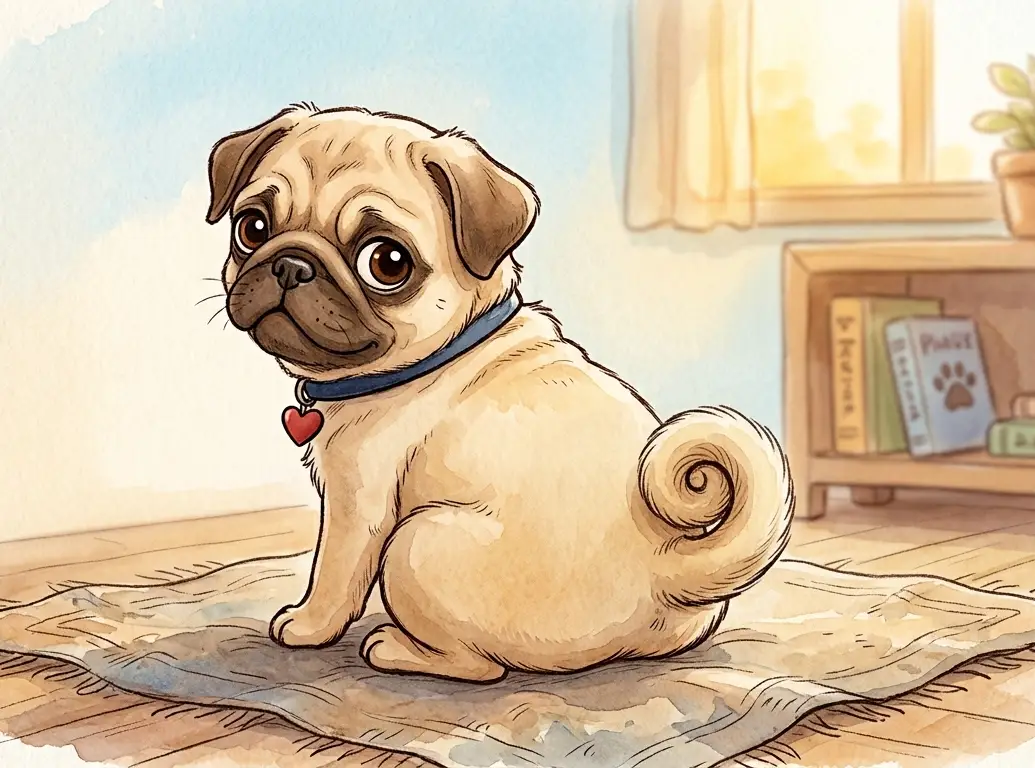
🐶 Pug Facts • The Curlicue Explained
Why Do Pugs Have Curly Tails?
The science behind the spiral, and what it means when it uncurls.
If you've ever met a pug, you've met that tail: a tight little cinnamon-roll of a curl perched on a round, wrinkly, snorty little dog. But why does it curl, is it healthy, and what does it mean when it suddenly goes straight? Here's the complete, no-fluff guide for pug parents.
🍬 The Short Answer
Key takeaways
📖 What's in this guide
1. The science of the curl •
2. Single vs. double curl •
3. Do all pugs have curly tails? •
4. Where the curl came from •
5. When the tail uncurls •
6. Tail positions decoded •
7. Is the curl healthy? •
8. How to care for the tail •
9. The tail that tells a story •
10. FAQ
🔬 The Science
Why does a pug's tail curl?
A pug's curly tail isn't a training trick, a grooming choice, or something that develops from how they sit. It's pure anatomy. The curl is caused by a naturally occurring trait called hemivertebrae, which literally means "half vertebrae."
Here's the mechanism. In a straight-tailed dog, the little bones running down the tail (the vertebrae) are roughly rectangular, so they stack neatly on top of each other in a straight line, like a stack of identical bricks. In a pug, several of those tail bones are wedge-shaped: fatter on one side than the other. When wedge-shaped bones stack together, they physically cannot form a straight line. Each wedge tilts the next one, and the whole tail is pulled around into a tight arc: the signature curlicue.
Picture building a tower out of blocks where a few are cut on a slant. The tower can't help but lean and spiral. That's exactly what's happening in a pug's tail, except the "slanted blocks" are bone, and the result is adorable instead of unstable. This trait is baked into the pug's genetics and has been part of the breed for centuries, so puppies are born with the tendency already present.
🌀 Curl Styles
Single curl vs. double curl
Not every pug tail curls to the same degree. You'll generally see three styles, and knowing the difference helps you understand what breeders and show judges look for.
Looks like: Loops around once into a neat spiral.
Breed view: Perfectly acceptable and very common.
✅ Completely healthy.
Looks like: Wraps around twice into a tight double coil.
Breed view: The ideal, prized in the show ring.
✅ Purely cosmetic distinction.
Looks like: A gentle hook rather than a full loop.
Breed view: Less favored in showing.
✅ Usually harmless variation.
The important thing for a pet owner: a double curl might win ribbons, but it does not make a pug a better companion, a healthier dog, or a happier one. A single-curled tail is every bit as charming on the couch at 8pm.
🐾 The Common Question
Do all pugs have curly tails?
Almost, but not quite. Because the curl is written into the breed's genetics, the overwhelming majority of pugs have a curled tail. That said, the tightness varies dog to dog, and a small number of pugs are born with looser or even nearly straight tails. That's a harmless natural variation, not a defect or a health warning on its own.
You'll also notice the curl tighten as your puppy grows. Many pug pups start life with a loose loop that coils up more firmly over their first several months as their muscles and tail bones mature. If your new puppy's tail isn't fully curled yet, give it time. Want more breed quirks like this one? We've rounded up 20 fun facts about pugs for kids, from their royal history to why a group of pugs is called a "grumble."
📜 Pug History
Where the curl came from
Pugs are one of the oldest dog breeds on record, with roots in ancient China where they were bred as companions for royalty. Over centuries of selective breeding for that flat, wrinkly, big-eyed "companion dog" look, the curled tail came along as part of the package, and it was deliberately favored because it fit the breed's compact, rounded silhouette. Today the curl is one of the defining traits written into the official pug breed standard, right alongside the wrinkled brow and the deep, expressive eyes.
📡 The Mood Barometer
What it means when a pug's tail uncurls
Here's the part most articles skip entirely, and it's the single most useful thing to know as a pug parent. That curl can act like a little mood barometer.
When a pug feels happy, alert, and secure, the tail sits up in its tight curl. When a pug is deeply relaxed or fast asleep, the tail often loosens and hangs straight, and that's completely normal. The muscles relax, and the coil relaxes with them. You'll see this every night when your pug is snoozing.
What deserves attention is a curl that drops and stays down while your pug is awake and active. A tail that suddenly hangs limp and straight for a day or more can be a signal that your pug is:
💚 Pug-parent tip
Learn your dog's normal curl now, while they're healthy. That way, if a normally tight tail suddenly droops and stays straight while your pug is up and about, you'll spot the change immediately and can treat it like any other early warning sign: a reason to check in with your vet.
🗣️ Tail Talk
Pug tail positions decoded
Once you start watching, you'll realize your pug is "talking" with that tail all day. Here's a quick translation guide.
Means: Happy, confident, feeling great.
Do: Enjoy it. This is your baseline.
Means: Excited, playful, greeting you.
Do: Play time!
Means: Deeply relaxed. Totally normal.
Do: Nothing. Let them rest.
Means: Stress, fear, discomfort, or illness.
Do: Watch closely. Call the vet if it lasts.
Means: Frightened or in pain.
Do: Remove the stressor. See a vet if it persists.
🩺 Health Check
Is a pug's curly tail healthy?
For the vast majority of pugs, the curly tail is completely painless and problem-free. It's simply the shape their tail bones grew into, and your pug feels nothing unusual about it at all.
The one thing worth understanding: the same genetic feature that curls the tail (hemivertebrae) can, in rarer cases, appear in the spine itself and cause discomfort or neurological issues. This is uncommon, and it's not caused by the tail curl. They just share the same underlying trait. Still, it's a good reason to have any sudden change, swelling, sensitivity, or sign of pain around the tail or lower back checked by a vet rather than brushed off.
• Tail loosens during deep sleep
• Puppy's curl tightens with age
• Single or double curl, held high when happy
• Slight variation in tightness
• Tail stays straight or limp while awake for a day or more
• Sudden swelling or a lump near the tail base
• Yelping, flinching, or pain when the tail is touched
• Redness, odor, or discharge in the tail fold
🧼 Simple Care
How to care for your pug's curly tail
Curly tails come with one small housekeeping job: the skin fold underneath the curl. Just like the famous folds on a pug's face, the tail's tuck can trap moisture, dead skin, and grime, which can lead to irritation or infection if ignored. Here's a simple 3-step routine.
📚 The Tail That Tells a Story
A curl that curls when she's happy, and goes straight when she's scared
Once you know that a pug's tail curls when they're happy and straightens when they're scared, you start seeing it as a tiny window into how your dog is feeling. It's such a charming, true little detail that it became the beating heart of a children's picture book.
In The Tall Tale of Twinky the Pug, our brave little hero has a curlicue tail that curls up tight when she's joyful and goes straight when she's scared. Across her big journey home, that tail becomes a quiet way for young readers to feel exactly what she's feeling. It's a gentle, wordless lesson in bravery that lands for boys and girls alike: her tail keeps straightening out, and she keeps going anyway. If your little one loves stories about courage, it fits right alongside these other children's books about being brave.
🐶 Meet the Pug With the Storytelling Tail
Follow Twinky all the way home
A read-aloud picture-book adventure for ages 5 to 8, where one curly tail says everything. Kindle $4.99 • Paperback also available.
❓ Good to Know
Frequently asked questions
👇 Tap any question to reveal the answer.
Do all pugs have curly tails?
Almost all pugs have curly tails because the curl is written into the breed's genetics. The tightness varies from dog to dog (some have a loose single curl, others a tight double curl), and a small number are born with naturally straighter tails, which is a harmless variation.
Why do pugs have curly tails?
Pugs have curly tails because of a genetic trait called hemivertebrae. The small bones in a pug's tail are wedge-shaped rather than rectangular, which forces the tail to coil into its signature curlicue instead of hanging straight.
Is it bad if my pug's tail is straight?
A pug's tail naturally relaxes and hangs straight during deep sleep, which is normal. But if your pug is awake and the tail stays limp or straight for a day or more, it can signal stress, pain, or illness, and is worth a call to your vet.
Can a pug's tail uncurl when they're sad or sick?
Yes. Many owners notice their pug's tail loosens or hangs straight when the dog is anxious, unwell, or in pain. The curl usually returns once the pug feels safe, warm, and happy again, which is why it's often called a mood barometer.
Do pug tails curl more as they get older?
Often, yes. Many pug puppies are born with a looser curl that tightens over the first several months as their tail bones and muscles develop. The final shape is usually set by the time the pug is fully grown.
What is a double curl on a pug?
A double curl is when the tail wraps around twice into a tight double coil, rather than looping just once. It's considered the ideal in the pug breed standard and is prized in the show ring, but it has no impact on a pug's health or personality.
Are curly tails painful for pugs?
For most pugs, the curly tail is not painful and causes no problems. It's simply the shape of their tail bones. In rare cases the same genetic feature can affect the spine and cause discomfort, so any sudden change, swelling, or sign of pain around the tail should be checked by a vet.
Can a pug's tail be docked or straightened?
No, and it shouldn't be. The curl is formed by the shape of the bones, not by a fixable tangle, so there's nothing to "straighten." Attempting to do so would injure the dog. The curl is a healthy, natural part of the breed.
Do other dog breeds have curly tails like pugs?
Yes. Breeds such as the Basenji, Akita, Shiba Inu, Samoyed, and Chow Chow all carry curled or curved tails, though the exact shape and cause vary. The pug's tight, hemivertebrae-driven double curl is one of the most distinctive.
Should I worry about my pug's curly tail?
Usually not at all. For most pugs it's simply an adorable, harmless feature. Just keep the tail fold clean and dry, learn your dog's normal curl, and check with your vet if the tail suddenly droops while awake or shows swelling, odor, or signs of pain.
Home of The Tall Tale of Twinky the Pug: stories, videos, and pug facts for kids and the grown-ups who read to them.
This article is for general informational purposes and reflects widely shared knowledge about pug anatomy and behavior. It is not a substitute for professional veterinary advice. If you're worried about your pug's tail or health, please contact your veterinarian.
© 2026 Twinky the Pug · By Keith Taylor · Privacy Policy